
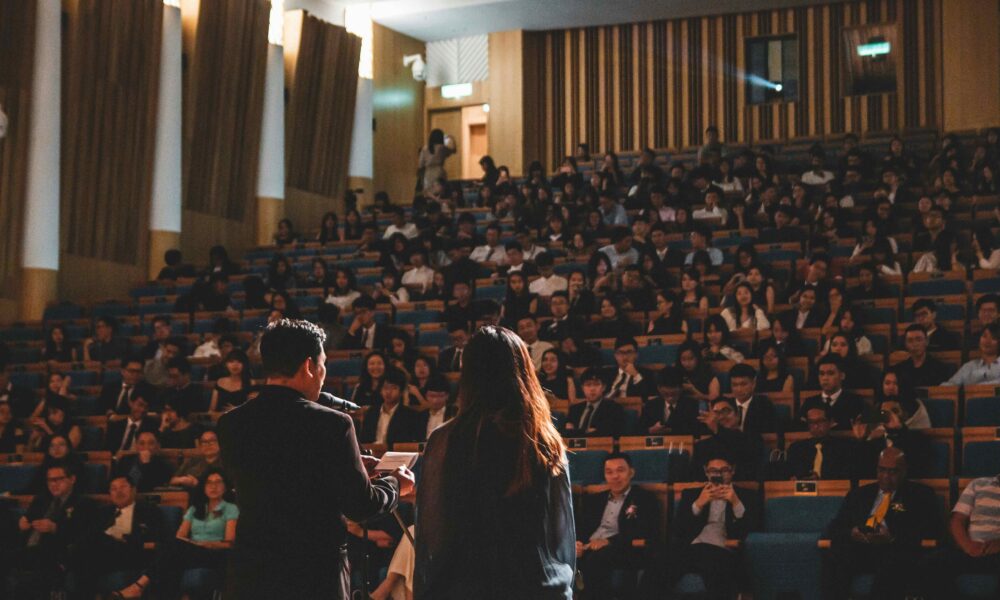
Government conferences have very little room for error. They bring together senior officials, ministers, MPs, external stakeholders and sometimes thousands of delegates, while operating under tighter security, procurement, accessibility and public scrutiny requirements than many commercial events.
The answer is strong public sector event management built around clear objectives, rigorous planning, robust production and experienced teams that can respond when circumstances change.
A government conference will look similar to many other conferences or trade shows from the outside. Behind the scenes, however, there are usually dozens of departments, suppliers, speakers and approval processes moving at once. Further additions like ministerial announcements, security requirements or last-minute changes to government policy can change the production plan at a moment’s notice.
The Guide Every Internal Comms Professional Needs
The 2026 Guide to Virtual Townhalls
Why is public sector event management so challenging?
Government conferences have very little room for error. They bring together senior officials, ministers, MPs, external stakeholders and sometimes thousands of delegates, while operating under tighter security, procurement, accessibility and public scrutiny requirements than many commercial events.
The answer is strong public sector event management built around clear objectives, rigorous planning, robust production and experienced teams that can respond when circumstances change.
A government conference will look similar to many other conferences or trade shows from the outside. Behind the scenes, however, there are usually dozens of departments, suppliers, speakers and approval processes moving at once. Further additions like ministerial announcements, security requirements or last-minute changes to government policy can change the production plan at a moment’s notice.
Why is public sector event management so challenging?
The biggest challenge is managing competing priorities without allowing any one of them to compromise the event. Government conferences need to be useful, accessible and engaging, but they also need to be secure, politically appropriate and defensible as a use of public money.
However, first step is the same as most events: establish what the event is actually supposed to achieve.
The frequent purposes of government events:
- Policy announcement
- Bringing public servants together
- Knowledge/expertise sharing
- Celebrating achievements
- Changing behaviour
For example, a senior leadership conference may need a very different format from a public-facing consultation. Whereas a policy announcement may require broadcast-quality production and a carefully controlled communications plan.
A clear objective is crucial if you want your public sector conference to have a coherent strategy.
How large government conferences can stretch internal teams
Scale creates pressure, but complexity creates the real strain. A 2,000-person government conference may involve multiple rooms, simultaneous sessions, senior speakers, broadcast requirements, security procedures, registration, accessibility services, catering, transport and several layers of approval.
Ultimately, complex public sector event production is less about production than it is about coordination.
A strong production team builds a clear chain of responsibility. Everyone knows who owns the decision, who needs to be informed and what happens if the original plan changes.
How do government teams manage security and confidentiality?
Security needs to be designed into every government event from the first planning meeting. Government events can involve ministers, senior civil servants, MPs, diplomats and other high-profile guests. Depending on the event, there may also be sensitive information, restricted sessions or commercially confidential discussions.
The event team therefore needs to consider:
- Who is attending?
- What information will be shared?
- Who is allowed into each area?
- How are credentials issued and checked?
- Where can photography and filming take place?
- How will VIP movements be managed?
- What happens if the programme changes?
- How will speakers and staff communicate securely?
The Security Industry Authority provides specific guidance around the roles that require licensed security personnel, while government security guidance also increasingly reflects the changing requirements around public venues and events.
The Terrorism (Protection of Premises) Act 2025, commonly referred to as Martyn’s Law, also introduced a new tiered approach to protective security for qualifying premises and events. Guidance was updated as recently as August 2026.
For an event team, the practical lesson is: security planning needs to sit alongside everything else from the outset.
What happens when government policy changes during event planning?
Policy uncertainty is one of the hardest variables for a government conference team to manage, but it is also a risk that every public sector event carries.
A policy announcement may need ministerial approval, legal checks, communications input, new presentation materials, media handling and changes to the event script. If the announcement is politically sensitive, even seemingly minor details can require careful review.
The production team needs enough flexibility to accommodate this without creating chaos elsewhere.
That means building contingency into the programme:
- Spare presentation slots
- Flexible scripts
- Editable graphics
- Adaptable stage content a clear process for approving changes
- The whole team briefed properly
Speakers, hosts, technicians, registration teams, stage managers and security staff should understand what they need to know, and, equally importantly, what they don’t.
How do government teams coordinate complex event production?
Don’t fall into the trap of treating the event like coordinating with a collection of suppliers but instead treat it like one connected project.
Large government conferences will involve external parties like venues, AV companies, caterers, registration providers, security teams, broadcasters, creative agencies, accessibility specialists and internal communications teams.
To avoid the whole thing becoming fragmented, your event will need a central production structure.
Here is a good public sector event plan that you can use at your government event or conference:
- A clear master timeline – including approvals, speaker deadlines, procurement, rehearsals and production milestones.
- Defined ownership – every significant task has one accountable person.
- A central event brief – the definitive reference point for the project.
- Regular production meetings – focused on decisions, risks and actions rather than simply reporting progress.
- A detailed show flow – covering every transition, speaker, video, presentation and technical cue.
- Contingency plans – particularly for technology, speakers, security and policy changes.
- A proper rehearsal process – it’s more expensive to discover a problem in front of 2,000 delegates than discovering it during a technical rehearsal.
This is where government departments look to enlist external event management. Internal government teams are often managing events alongside their normal responsibilities. They may have deep subject expertise and strong stakeholder relationships, but limited capacity for the hundreds of operational details that sit underneath a major conference.
External support can provide additional project management and production capacity without taking ownership away from the government team.
How important is inclusive conference planning?
Government event organisers need to consider accessibility and inclusivity from the beginning of event design and build it into everything that comes after.
That includes the venue, registration process, website, communications, presentations, signage, seating, catering, transport and digital experience.
The UK Government’s current guidance on communicating with people with disabilities specifically recommends considering accessibility across every aspect of an event, including publicity, venue facilities, staff, speakers and exhibitors. It also warns that meeting accessibility needs becomes more expensive and difficult when considered late.
With hybrid events, that inclusive approach must extend to the digital audience:
- Can remote delegates hear every speaker?
- Can they access presentations?
- Can captions be provided?
- Can they participate in Q&A?
- Are recordings available where appropriate?
These details matter because a conference can have an excellent stage experience while excluding a huge part of its audience.
Which hybrid and virtual event platforms suit large UK public sector organisations?
The most effective event technology does more than register delegates or put a conference online. It helps organisers understand who is attending, shape their experience and demonstrate what the event achieved.
This matters for large public sector events because government audiences are rarely homogeneous. A room might contain senior civil servants, operational teams, policy specialists, external partners and industry representatives, all arriving with different levels of knowledge, different responsibilities and different reasons for being there.
This is where AudienceDNA and Envoku by Live Group can add another layer to event planning.
AudienceDNA is an audience profiling tool that looks beyond basic registration data to understand differences in personality, learning styles, preferences and needs. This can help organisers build a clearer picture of who is attending and consider how different groups may engage with the event.
Live Group’s in-house event platform, Envoku, can then use this information alongside factors such as job function and interests to shape different delegate journeys. It also brings together registration, attendance and engagement data in dashboards, giving government teams a clearer picture of participation and helping them assess the value and impact of an event.
Microsoft Teams, Zoom and other platforms may provide the infrastructure for virtual or hybrid participation. But the wider technology ecosystem should answer a bigger question: Who are we bringing together, what do they need from this event, and how will we know whether it worked?
From here, audience insight and event technology start to become part of the event strategy.
Why should a government agency or department hold events?
Government events are valuable when bringing people together achieves something that email, a report or a video call cannot.
A well-designed conference can:
- communicate major policy changes
- bring different departments together
- share knowledge and professional expertise
- consult stakeholders
- build communities of practice
- recognise public service achievements
- create opportunities for collaboration
- engage citizens and external organisations
- provide leadership visibility
- turn complex policy into something people can understand and discuss
When Live Group produced the Government Finance Function Conference, they designed it around bringing finance leaders together, sharing strategic priorities and creating opportunities for discussion and peer connection. If 2,000 people attend a conference and leave without learning, contributing or changing anything, the event has generated a large registration number but limited value.
Good government events start with the change they want to create and work backwards from there.
How much funding can the government give an event?
There is no single government pot or standard funding amount for conferences. Funding depends on the programme, department, purpose, eligibility and economic or public value of the event.
Government funding can range from relatively modest grants for specific local or national events to substantial investment in major events.
For example, the Ministry of Defence awarded £50,000 to the successful host town of the 2027 National Armed Forces Day event, alongside access to military assets and planning and communications support.
At the other end of the spectrum, the government’s major-event funding framework describes direct UK government investment as being aimed at the largest and most significant events. For major sporting events, the framework refers to events with staging costs above £10 million and says government support is considered case by case, based on factors including affordability, financial need and value to the taxpayer.
For most government conferences, therefore, the more useful question is not “How much will the government fund?” but “What value will this event deliver, and can that value be demonstrated against its cost?”
That brings us neatly to the issue of optics.
Why does public perception matter so much?
A government conference must withstand scrutiny.
An expensive-looking production can attract criticism even if it delivered strong outcomes. A cheap-looking event can create its own problems if delegates conclude that the organisation hasn’t invested enough in communicating an important issue. The sweet spot is purposeful production.
Every major spend should have a reason behind it. Hiring a large screen is good if it might improve visibility for 1,500 delegates, but not if it’s just a vanity investment. Professional filming might extend the reach of a policy announcement, but it might not be as worth it for internal sharing.
Other investments include better registration technology to reduce queues or a hybrid platform might allow staff who cannot travel to participate.
The question should always be: what does this investment achieve? That’s particularly important when public money is involved.
Can an external event production agency reduce the pressure?
Yes. A full-service events agency can give government teams the additional capacity, production expertise and operational control needed to manage large conferences without losing sight of the wider objective.
For example, Live Group works across in-person, hybrid and virtual events, bringing event management, production, registration, digital delivery and onsite logistics together under one team. Its work with the UK Government includes the delivery of large hybrid conferences designed around different learning styles, engagement and strategic discussion.
A government conference probably won’t fail because somebody forgot to book a microphone. It does become difficult however, when dozens of small decisions collide.
An event production agency can take responsibility for connecting those decisions: turning the brief into a workable programme, coordinating suppliers, managing the production schedule, preparing speakers, testing technology, planning contingencies and keeping the event moving when the inevitable curveballs arrive.
The best event managers know that the plan will change. The trick is making sure the plan is strong enough to absorb the change.
Public Sector Events: The bottom line
Government conferences demand a particular kind of event management. They need the polish of a major corporate conference, the discipline of a complex project and the judgement required when politics, policy, security and public money are involved, and these pressures are connected.
Clear objectives lead to better planning. Better planning creates stronger production. Stronger production gives teams room to respond when circumstances change. And that flexibility is what ultimately protects the delegate experience.
Live Group partners with enterprise, professional services, and public sector organisations to plan and deliver complex events without the last-minute scramble. Get in touch to talk through your next event.
Get the latest guide on virtual town hall meetings.
Ready to take the stress out of event planning?
Live Group helps organisations design and deliver personalised event experiences that engage audiences and achieve results. Contact us to discuss your next event.
Large government conferences place pressure on production teams because of their scale, number of stakeholders and high level of operational risk. Multiple rooms, senior speakers, security requirements, hybrid audiences, accessibility needs, live broadcast and last-minute policy changes can all need to be managed simultaneously.
Microsoft Teams is widely used across UK government and benefits from specific Microsoft 365 guidance for UK Government organisations. Zoom is also used in some government settings, while other platforms such as Webex or Google Meet may be appropriate depending on organisational requirements and approvals. For major conferences, the conferencing platform may sit alongside a dedicated registration and event platform, streaming infrastructure and professional production.
They need a single master plan covering objectives, stakeholders, procurement, speakers, content, venue, security, technology, accessibility and production. Clear ownership, regular production meetings, detailed show flows and technical rehearsals then keep the different workstreams connected.
Government events can communicate policy, share knowledge, consult stakeholders, build professional communities, recognise achievement and bring people together for discussion that would be difficult to replicate through written communications alone.
There is no standard amount for government conferences. Funding varies according to the scheme and purpose. Some national events receive specific grants — the 2027 National Armed Forces Day host, for example, will receive £50,000 — while major-event investment can reach much higher levels and is assessed case by case.
Build accessibility into the event from the beginning. Consider accessible venues, registration, communications, signage, seating, presentations, captions, participation methods and digital access. UK Government guidance recommends addressing accessibility across the whole event rather than leaving it until the final stages.
Look beyond the ability to deliver a good-looking conference. Experience with public sector environments, complex production, security, senior stakeholders, hybrid delivery, accessibility, contingency planning and public scrutiny can be just as important as creative capability.