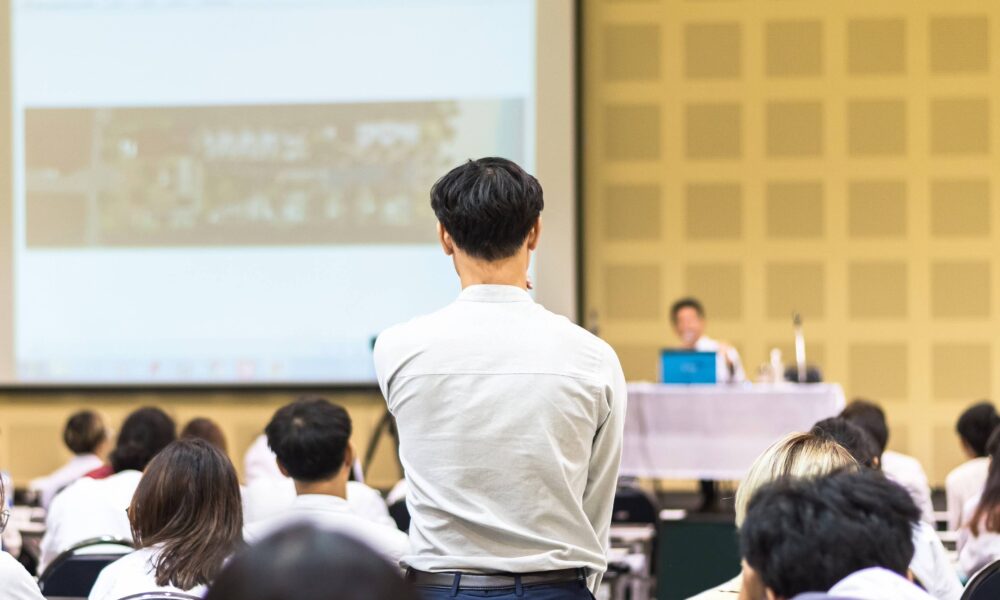
Most of your town hall audience will never ask a question. A small, confident group does the talking, polls reach far more people, and the majority stays silent. If you want to know what your organisation really thinks, design the town hall for the silent majority: poll for breadth, take questions in writing as well as aloud, and treat silence itself as data.
That’s the heart of chapter four of The Audience Report 2026, and the timing’s apt. Year-end town halls are filling diaries, 2027 strategies are about to be unveiled, and plenty of leadership teams are at risk of reading 5 questions from the floor as the mood of an entire organisation.
Free E-Book
The Audience Report 2026
Who actually participates in a town hall?
Far fewer people than the room suggests, and how many depends on how you ask. ON24’s 2026 platform data averages 1.8 interactions per attendee per webinar, counting every poll answer, download, reaction and question. In its 2025 data, the average event drew 130 poll responses but only 14 questions. Polling ran roughly ten times higher than Q&A.
Research on conference Q&A points the same way. A 2023 study in the journal Sex Roles counted 436 Q&A interactions across 3,888 attendees at one conference, and 601 across more than 10,000 at another. That’s roughly one question for every 10 to 20 people. Bizzabo’s data shows about 47.3% of attendees use chat or discussion features at all.
| How people can take part | Who it reaches | What it costs the participant |
| Live poll | Most of the room | One tap, anonymous, low risk |
| Chat or typed questions | A wider group than the microphone | A few words, partly visible |
| Live microphone Q&A | A small, confident minority | Standing up in public in front of leaders |
| Saying nothing | Most people, most of the time | Nothing |
The channel you offer decides who you hear from, so choose it on purpose.
Why do so many people stay silent?
Because speaking up at a town hall is socially expensive. Asking a question means standing in front of colleagues, often with the CEO looking straight at you, and putting your name to a worry. Many people decide the risk isn’t worth it, even when the question matters to them.
Employees trust their employers more than almost any other institution. The 2026 Edelman Trust Barometer, with nearly 34,000 respondents across 28 countries, found 78% of employees trust their employer, well ahead of business generally at 64% and government at 53%. So why the silence?
Trusting an organisation and feeling safe to question its leaders in public are two different things. You can believe your employer means well and still not fancy being the person who asks about redundancies in front of 800 colleagues. Read that silence as caution, and design around it.
Silence at a town hall usually signals social risk, not a lack of questions.
Who dominates town hall Q&A?
The confident and the senior, and the audience demographics make it plain. The same Sex Roles study found that in one virtual conference, men made up 42% of attendees but took 62% of Q&A time.
| Setting | Men’s share of attendees | Men’s share of Q&A |
| Virtual conference | 42% | 62% of Q&A time |
| Second conference | 60% | 80% of Q&A time |
| Female-majority conference | 31% | 39% of Q&A interactions |
Moving online didn’t fix it. The imbalance was much the same in person and on screen, so a virtual town hall won’t automatically hear a fairer mix of voices. The way people asked did shift things, though. Women asked 53% of typed chat questions, against 44% of questions asked on video. The researchers were careful to say format changes only narrowed the overall gap a little, and that the gap was smaller among more senior attendees.
Think about what that means for a typical all-hands. The people most likely to grab the microphone are the people already closest to power. The people with the least power, often those most affected by the strategy on the slides, are the least likely to ask.
A live microphone isn’t neutral: it over-samples the bold and the senior.
Are town hall polls more representative than Q&A?
Yes, for breadth. Polls reach roughly ten times more people because they’re quick and anonymous, so they give you a much fairer read of the whole room. Tools like Slido, Mentimeter, Vevox and the built-in polls in Microsoft Teams make them easy to run at any size.
Polls have a blind spot, though. They only answer the questions you thought to ask. A poll can tell you 60% of people feel unclear about the new structure. It can’t tell you why. It also doesn’t alert you to issues you hadn’t considered. That’s where questions come in.
So the answer is both, each doing its own job:
- Poll for breadth: how many people feel this way?
- Use Q&A for depth: why do they feel this way, and what do they need?
Use polls to hear everyone and questions to understand them.
Should town hall questions be anonymous?
Usually yes, with a safety valve. Anonymous questions draw a broader and more honest set, including the ones people would otherwise only ask by the kettle afterwards. The trade-off is accountability. In a low-trust organisation, a fully anonymous session can turn into a queue of grievances.
Anonymity widens who speaks, yet Gallagher’s 2026 internal communications research suggests that where trust is lowest, people value in-person listening sessions most. Both are true. Anonymity lowers the barrier to asking; face-to-face contact is what rebuilds trust afterwards.
Live Group’s preferred set-up is anonymous submission with moderated or named follow-up where it’s useful. It lowers the barrier, keeps a route open to real conversation, and can be dialled up or down to suit the culture.
Anonymous questions widen the net, and face-to-face follow-up keeps it honest.
What is the silent majority actually worried about?
Consequences, more than content. Live Group’s analysis of Q&A across delivered programmes keeps finding two types of question. Content questions ask for detail or evidence. Consequence questions ask what a decision means for my role, my team or my next step.
There’s plenty feeding those consequence questions right now. Edelman found around two-thirds of employees worry trade policies and tariffs will harm their employer, and 54% of low-income and 44% of middle-income respondents believe generative AI will leave them behind. Gallagher found only 27% of organisations say their strategy documents are well understood, and 87% see line manager communication as a moderate or significant risk.
The most revealing data of all is the questions nobody asks. If leaders see a topic as central and it draws no questions, people either don’t understand it well enough to ask, or don’t believe they’ll get a straight answer.
| Code | Example | What it tells you |
| Content | “Can you share the data behind the growth target?” | The message landed but needs evidence |
| Consequence | “What does the new structure mean for my team?” | People need the strategy translated into their reality |
| Silence | No questions on a topic leaders see as central | Confusion, or doubt that an honest answer is available |
Code every question the same way across a year of town halls, and you’ll build a running record of what your people really worry about.
How do you design a town hall that hears everyone?
Build participation into every stage, not just the last ten minutes. Here’s a simple plan:
| Stage | What to do | Who it brings in |
| Before | Open anonymous question submission a week ahead | People who need time or privacy to ask |
| Opening | Start with a live poll on the topic people care about most | The whole room, from minute one |
| Middle | Take typed and spoken questions, and have the moderator balance them | Quieter voices alongside confident ones |
| Close | Poll once more: “What’s still unclear?” | The silent majority, one last time |
| After | Answer unasked and unanswered questions in a follow-up, and code them all | Everyone, plus a record for next time |
A good moderator is even more important than the tool. Their job is to make sure the queue reflects the room, not just whoever typed fastest or stood up first.
When you design for the silent majority, the confident few will still be heard.
Where does an events agency fit in?
Running a town hall that hears everyone means choosing the right tools, briefing moderators, writing the polls, setting up anonymous submission and coding every question afterwards. That’s a lot to carry alongside the day job. Partnering with a full-service events agency means it happens properly and consistently, across every all-hands and leadership event. Live Group runs the Q&A and polling layer and turns what the audience says, and doesn’t say, into insight leaders can act on.
With the right partner, your town hall hears the whole room.
Want the full picture?
This article covers chapter four of The Audience Report 2026. The full report also covers attention, attendance, session formats and post-event action.
Download the free report.

Ready to take the stress out of event planning?
Live Group helps organisations design and deliver personalised event experiences that engage audiences and achieve results. Contact us to discuss your next event.
Very few. Studies of conference Q&A found roughly one question for every 10 to 20 attendees, while polls reach about ten times more people than Q&A.
They do different jobs. Polls give a representative read of the whole room; questions explain why people feel the way they do. Use both.
Anonymous submission widens who asks. Pair it with moderated or named follow-up so questions stay constructive.