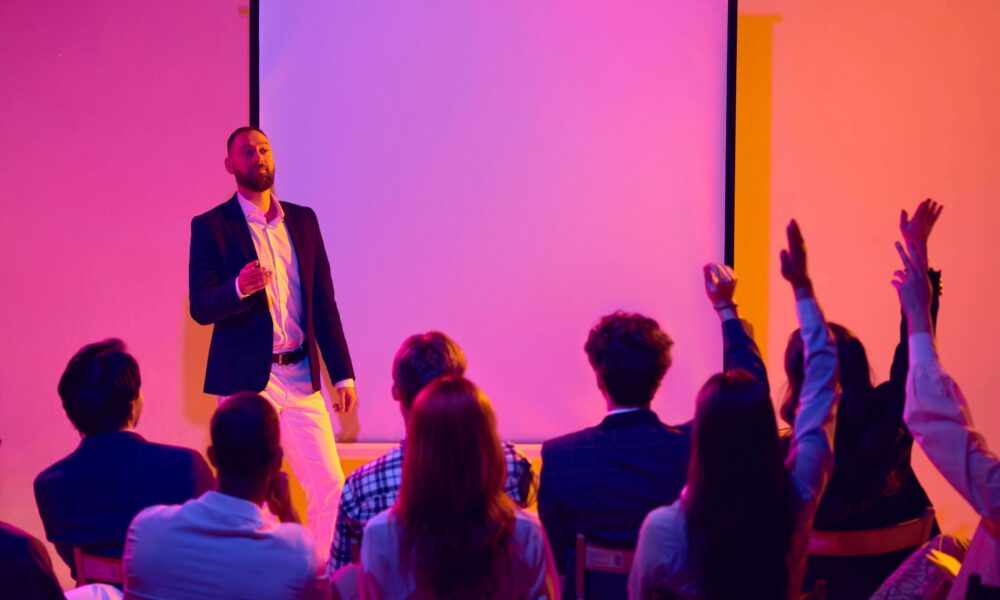
Hands-on and demonstration formats hold event attention longest. Uninterrupted single-voice talks hold it least. The formats in between hold attention if: the audience has to do something, and whether they have a reason to care about the content.
That second part matters more than most agendas admit. Attention is part a voluntary decision and part involuntary reflex, and both can be designed for. Chapter three of The Audience Report 2026 covers the decision side. The brain science covers the reflex.
Free E-Book
The Audience Report 2026
Which event session format holds attention best?
The more the audience acts, the longer the format holds them. Here’s how the main event formats compare:
| Event format | Attention it holds | Why |
| Hands-on and demonstrations | Highest | People handle something; 57% of attendees rate demos most useful for judging a product |
| Small-group work and roundtables | High | Active learning works best in groups of 50 or fewer |
| Interactive plenaries (polls and Q&A throughout) | Moderate to high | Each interaction resets attention for what follows |
| Panels | Moderate | Pace and contrast help, but the audience often sits back |
| Uninterrupted single-voice talk | Lowest | The baseline every other format beats |
Session format won’t do all the heavy lifting alone. Great content and sharp facilitation can lift any session a rung or two, and a dry demo can turn people off if they don’t feel invested. Start with the ladder, then let content and facilitation do the rest.
Why does ‘doing’ beat ‘listening’?
The brain reacts to change before we decide to notice it. Neuroscientists study this with event-related brain potentials, tiny shifts in electrical activity recorded through EEG sensors on the scalp and timed to the moment something happens. One well-studied brain potential, the P300, appears roughly a third of a second after a new or task-relevant stimulus. Its strength rises with how much attention that stimulus pulls in.
That’s why novelty works in events. A new voice, a sudden question or a poll lighting up on everyone’s phone registers as “something has changed” and pulls focus. It also explains a finding from chapter one of the report: in a 2010 study by Bunce, Flens and Neiles, students lapsed far less during demos, group work and clicker questions, and their attention stayed higher in the lecture segment that followed.
The catch is that novelty fades fast once it becomes routine. Swap speakers every ten minutes and the brain soon learns the pattern. Change the type of activity, from listening to voting to talking to trying, and each shift still counts as news.
Varying the format doesn’t just mean changing the face on the stage, but a mix of activities means the brain keeps paying attention.
How do emotion and attention work together?
Emotion acts as a priority pass for attention. Research reviewed by the neuroscientist Patrik Vuilleumier in Trends in Cognitive Sciences shows that emotionally significant information gets fast-tracked: the amygdala flags it, and the brain’s attention systems move it up the queue. Emotional images also produce a larger late brain potential in EEG studies, a sign that people keep processing them for longer.
And emotional arousal helps memory too. Decades of work by James McGaugh and others show that moments with emotional weight are more likely to be remembered later. For an event, that’s the difference between a session people sat through and one they talk about on the train home.
That doesn’t mean every event should become a highlight reel. Freeman found 78% of organisers believe they deliver a peak moment, yet only 40% of attendees say they experienced one. Spectacle produces a reaction in the moment, but emotion only drives attention when it’s attached to something the audience cares about: their job, their team, their next decision.
The emotion that holds attention is personal stakes, delivered at the right moment.
How do you capture event attendee attention?
Start early, make it personal, and give people something to do. Attention lapses can begin within 30 seconds of a session starting, so the opening minute matters most. Here’s a simple sequence that works for most event formats:
| When | What to do | What it targets |
| First minute | Open with a question about the audience’s own situation | Emotion and relevance |
| Minute 10 to 12 | Run a live poll on Slido or Mentimeter | Novelty and a format change |
| Middle | Tell one real story with something at stake | Emotional weight and memory |
| Two-thirds in | Short pair discussion or hands-on task | Active processing |
| Close | Everyone writes down one action and a date | Turning attention into behaviour |
None of this needs a bigger budget. It needs someone to ask, at the planning stage, what each audience member stands to gain or lose from the session.
Capture attention with relevance first, then hold it with regular changes of format.
Does event dwell time depend on the format?
Yes, and the virtual gap is the number every hybrid planner should know. Bizzabo reports virtual sessions are completed at 71% of their length on average, with 46 minutes of viewing per session. In-person sessions reach 98.5%.
| Setting | Dwell time or engagement | Source |
| In-person session | 98.5% completion | Bizzabo |
| Virtual session | 71% completion, 46 minutes average viewing | Bizzabo |
| Webinar with heavy interaction | 49 minutes average engagement | ON24 |
| Webinar replay, 31 to 45 minutes | More than twice the engagement of replays under 30 minutes | Wistia |
ON24’s 49 minutes comes from webinars packed with interaction: on average 150 poll responses, 101 downloads, 52 reactions and 19 survey responses each. Length and interaction rise together. Wistia’s 2026 State of Video report adds that for webinar replays, recordings of 31 to 45 minutes earned more than twice the engagement of shorter ones.
Session length alone doesn’t determine dwell time, but having a reason to stay does.
What do attendees want from an event format?
More freedom than most agendas give them. Freeman’s 2026 research with more than 3,300 attendees and exhibitors, reported through Skift Meetings, found attendees want 54% of their learning time in unstructured formats, rising to 64% at trade shows. Nearly two-thirds of Gen Z and Millennial attendees want learning beyond the session room.
That sounds like it clashes with everything above. It doesn’t, quite. “Unstructured” describes how the time feels to the delegate. A networking session with set themes, a host and a reason to talk feels free, and it’s still carefully designed.
Give attendees freedom, and design that freedom on purpose.
Can participation work in a room of 2,000?
There’s no hard limit to how many attendees can participate. The Freeman meta-analysis found benefits at every audience size, so scale changes how you design participation rather than whether it works. Big audiences can vote, rank priorities, submit questions or turn to a neighbour for three minutes.
To see where you stand, work out your participation ratio: the minutes in which the audience must do something, divided by total programmed minutes. A two-day conference with 12 hours of sessions and two active hours scores about 17%. It takes 20 minutes with a spreadsheet, and the answer is usually sobering.
Know your participation ratio before you sign off the agenda.
Where does an events agency fit in?
Rebalancing an agenda sounds simple until you’re juggling speakers, sponsors and fixed room sizes. Partnering with a full-service events agency means someone can redesign the format mix, write sessions around what’s at stake for the audience, run the polling and facilitation, and measure attention by format across in-person and virtual audiences. Live Group does this week in, week out, so the science above turns into an agenda people stay for.
The research is clear; a good partner makes it happen on the day.
Want the full picture?
This article draws on chapter three of The Audience Report 2026. The full report covers attention, attendance, Q&A, post-event action and what top-performing events measure. Download the free report.
Ready to take the stress out of event planning?
Live Group helps organisations design and deliver personalised event experiences that engage audiences and achieve results. Contact us to discuss your next event.
Hands-on and demonstration formats, followed by small-group work and roundtables. Uninterrupted single-voice talks hold attention least.
Open with something personally relevant, change the format every 10 to 15 minutes, and give people a task such as a poll, a discussion or a short exercise.
Emotionally significant content is prioritised by the brain and remembered better, as long as it connects to something the audience cares about.