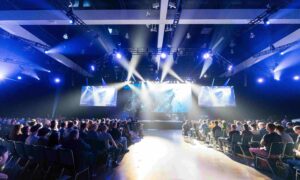
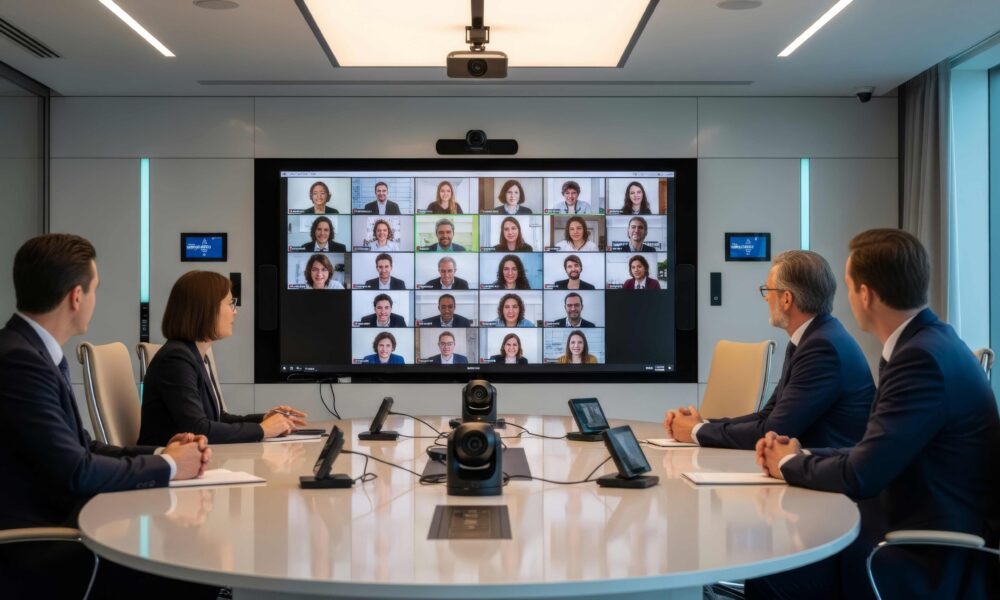
Running a hybrid conference with attendees across multiple continents, time zones, and technical environments is one of the most operationally demanding formats in the events industry. Most organisations that attempt it for the first time discover this too late, after a programme that felt manageable in a planning spreadsheet has become a coordination problem in practice.
The organisations that do it well, FTSE 100 companies managing global all-hands events, government departments hosting international policy forums, large enterprises running multi-region roadshows, tend to share a set of operational disciplines that less experienced teams overlook.
This article covers the specific steps and structural decisions that make global hybrid conferences run more smoothly in 2026.
The Guide Every Internal Comms Professional Needs
The Internal Comms Bible 2026
Why Global Hybrid Conferences Fail
Before addressing what works, it is worth being direct about the failure modes. Most global hybrid conference problems trace back to one of four root causes.
Treating hybrid as an afterthought
When the physical event is designed first and the digital layer is added on top, remote delegates experience a secondary event. They watch rather than participate. Connection quality is variable. Their questions are answered last, if at all. This design sequence is the single most common source of hybrid dissatisfaction, and the fix is to design for both audiences simultaneously from the brief stage.
Underestimating time zone complexity
A keynote timed for 09:00 London works for EMEA but runs at 04:00 on the US East Coast and 17:00 in Singapore. Global conferences need explicit decisions about which audience gets the live programme and which gets a high-quality recorded version, along with a content strategy for each scenario.
Platform fragmentation
Using one tool for registration, a different one for the live stream, another for Q&A, and a separate app for networking creates friction at every handover point. For delegates who are already at a distance, technical friction is the fastest route to disengagement. Integrated platforms that handle multiple functions reduce this risk significantly.
Insufficient technical rehearsal
Global hybrid events involve more technical variables than any other format. Speaker feeds from multiple locations, language switching, moderator handovers across time zones, and simultaneous content streams all need to be tested under realistic conditions before the live event.
Step 1: Establish a Single Point of Accountability
Global hybrid conferences require one person or one agency with clear authority and responsibility for the whole programme, both physical and digital, regardless of how many venues or locations are involved.
Distributed accountability, where the in-person production team and the digital platform team operate independently, is a structural risk. Decisions about programme flow, technical contingencies, and audience experience need to be made quickly and consistently. That requires a single operational lead who understands both dimensions.
For large enterprises working with an external agency, this means selecting a full-service partner rather than assembling a fragmented supplier list. The coordination overhead of managing multiple specialist vendors across time zones adds complexity that rarely justifies the perceived cost saving.
Step 2: Design for Both Audiences from Day One
Gone are the days of an in-person event with a camera being sufficient. The most effective global hybrid conferences are designed as integrated programmes where the physical and digital experiences are developed in parallel, with explicit decisions made at each stage about how both audiences will experience each moment.
Practical implications of this approach include:
- Stage design and camera placement that treats remote delegates as a primary audience
- Moderators briefed to draw questions from both physical and virtual attendees in equal measure
- Networking formats designed to work across in-person and digital participants simultaneously
- Content pacing that accounts for the different attention dynamics of remote versus in-room audiences
- Visual and graphic design optimised for both large-screen venue display and laptop or tablet screens
Hybrid events only work when remote delegates are not treated as second-class attendees.
Step 3: Rationalise Your Technology Stack
The technology choices made at planning stage determine how much operational complexity your team carries on the day of your hybrid conference. The key principle is consolidation. Every additional platform in your stack creates an additional handover point, an additional failure mode, and an additional layer of delegate friction.
For enterprise-scale hybrid conferences, the platform needs to handle registration and delegate management, personalised agenda tools, livestreaming and on-demand content, breakout rooms and networking, live polling and Q&A, and post-event analytics within a single coherent environment.
Purpose-built hybrid event platforms are better equipped for this than general-purpose video conferencing tools or event apps assembled from separate components. Platforms like Envoku are specifically designed for complex hybrid delivery, integrating personalisation, streaming, and engagement analytics within a single architecture.
For public sector and FTSE 100 organisations, security and data governance requirements add another layer of evaluation criteria. Any platform shortlist needs to address data residency, access controls, and compliance with relevant regulatory frameworks before other capabilities are assessed.
Step 4: Build a Time Zone Strategy
A time zone strategy is not simply a decision about when to hold the event. It is a structured approach to ensuring every audience segment has a meaningful experience regardless of where they are located.
The key decisions are:
- Which content is broadcast live and to which audience segments?
- Which sessions are recorded and released on-demand, and what is the release schedule?
- Are there regional breakout sessions that run at locally appropriate times alongside a global programme?
- How are pre-event communications and agenda access timed across different time zones?
- What is the on-demand content strategy for delegates who could not attend live?
Platforms with strong on-demand content management make the time zone problem significantly more manageable. When sessions are automatically captured, tagged, and made available through a gated content hub, remote delegates in challenging time zones have a genuinely useful alternative to a live feed at 03:00.

Step 5: Invest in Technical Rehearsal
For a global hybrid conference, it is a non-negotiable to make the time investment for a technical rehearsal. It’s one of those components that your delegates may not see but are aware of when it doesn’t happen.
Rehearsal for this format needs to go further than testing that the stream works. It should simulate realistic conditions: speakers joining from different locations, moderator handovers across time zones, Q&A flows between physical and digital audiences, and contingency procedures for the technical failures that will inevitably occur at some point during a live global programme.
The agencies that consistently deliver clean global hybrid conferences allocate substantial rehearsal time, often multiple full-day sessions, and treat the rehearsal schedule as a non-negotiable element of the production timeline.
Step 6: Use Data to Manage in Real Time
Global hybrid conferences generate a continuous stream of engagement data that can be used to improve the programme while it is running, not just to evaluate it afterwards.
Live dashboards showing session attendance by location, Q&A participation rates across physical and digital audiences, and real-time engagement scores allow the production team and event director to make informed decisions in the moment: adjusting session timing, extending or condensing content, or triggering additional networking time if energy drops.
Agencies with genuine data capability treat this real-time intelligence as a production tool rather than a post-event reporting function. It is one of the clearest indicators of whether a prospective partner is equipped for the complexity of global hybrid delivery.
Step 7: Plan for Localisation
For truly global programmes, localisation is more than translation. It includes consideration of cultural communication norms, local regulatory requirements for certain types of content, regional examples and references within presentations, and logistical considerations around local venue partners and production crews.
Large enterprises and government organisations running international hybrid conferences increasingly require their event partners to have established global supplier networks and local market knowledge. Agencies operating only from a UK base without international production capability introduce risk that can be managed but cannot be eliminated.
Final Word on how to Streamline a Hybrid Conference in 2026
Streamlining a global hybrid conference in 2026 is fundamentally an organisational and design challenge, even more than overcoming technology limitations. The platforms exist, the production capability exists. What separates successful programmes from problematic ones is the discipline to make clear structural decisions early: single accountability, integrated design, consolidated technology, explicit time zone strategy, and sufficient rehearsal.
For FTSE 100 and large public sector organisations, these decisions are worth making carefully. A global hybrid conference that lands well accelerates alignment, builds confidence in leadership, and generates engagement data that improves every future event. One that does not land well takes time and budget to recover from.
Why Global Enterprises Choose Live Group for Hybrid Conference Delivery
Live Group has spent five decades delivering complex events for some of the world’s largest organisations, including FTSE 100 companies, global enterprises, and major public sector bodies. For hybrid conferences that span multiple continents, time zones, and audience types, that depth of experience translates directly into fewer surprises on the day.
What distinguishes Live Group from specialist platform vendors or single-discipline production houses is the end-to-end model. Strategy, content design, physical production, digital delivery, and post-event analytics sit within a single team rather than being distributed across a fragmented supplier list. For global programmes where coordination overhead is already high, that consolidation matters.
At the centre of Live Group’s hybrid delivery capability is Envoku, a purpose-built platform designed specifically for complex hybrid and virtual events. Rather than adapting general-purpose conferencing tools to enterprise requirements, Envoku is architected for personalised delegate journeys, integrated streaming and on-demand content, live engagement analytics, and the security and data governance standards that FTSE 100 and public sector clients require. It handles the full delegate experience, from registration through to post-event content access, within a single coherent environment.
For organisations planning a global hybrid conference in 2026, Live Group offers an initial consultation to assess your programme requirements, audience complexity, and technology needs before any commitment is made.
Get the latest report on internal communications in 2026.

Ready to take the stress out of event planning?
Live Group helps organisations design and deliver personalised event experiences that engage audiences and achieve results. Contact us to discuss your next event.