Visual Communication in Events: Why Leaders Need More Than Words
Why don’t teams usually remember the all-staff update from last quarter, no matter how important or eloquently delivered? If it arrived as a long email, a text-heavy slide deck, or a town hall where someone read bullet points off the screen, that could be the culprit.
That’s the problem with a lot of leadership communication right now. The message matters, but how are recipients experiencing that message?
That’s why visual communication has become such a big conversation across events, internal communications, and leadership teams – because audiences and their expectations have changed. People process information faster, more visually and more emotionally.
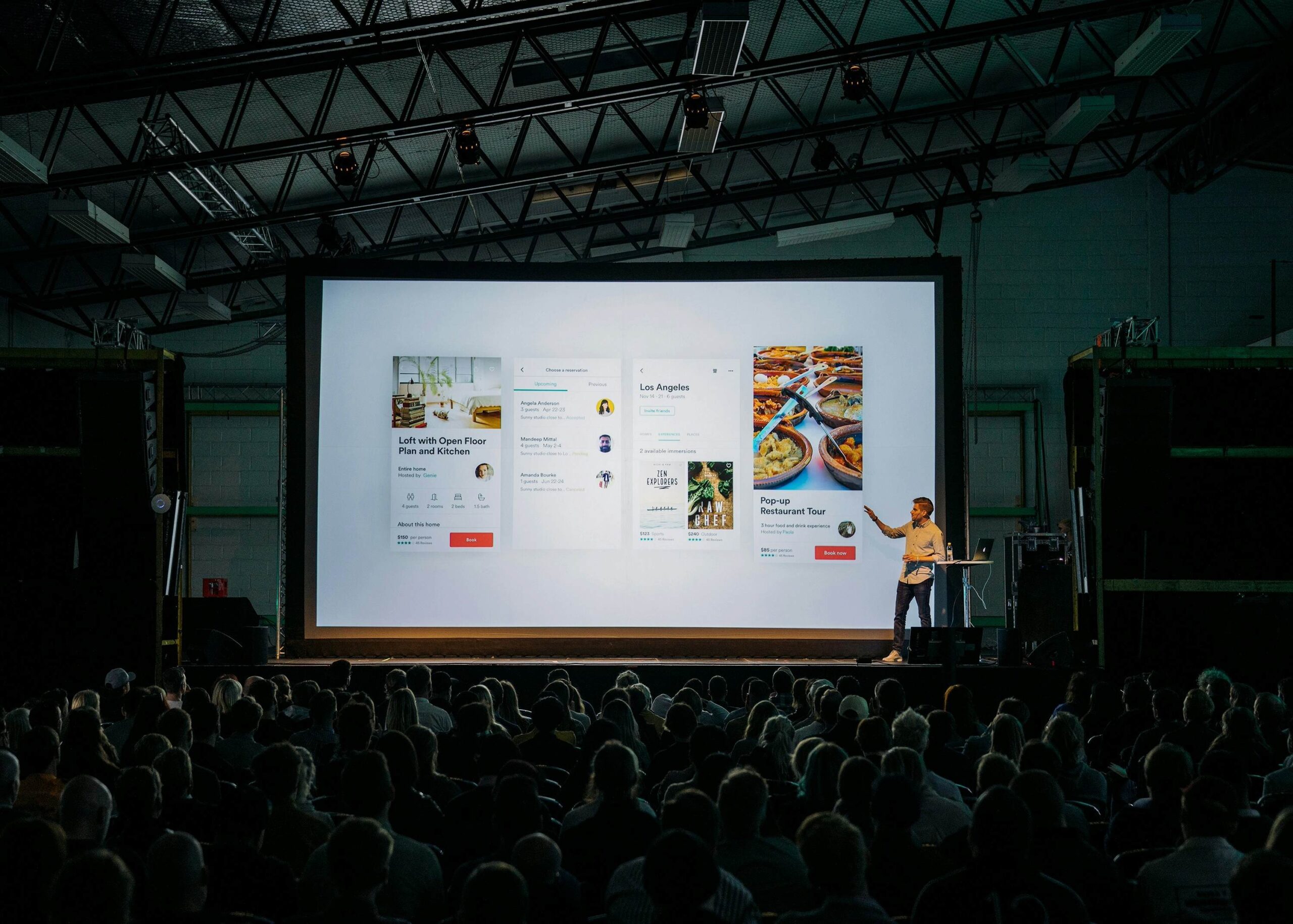
Think about how most of us consume content outside work. Short-form video, infographics, podcasts with subtitles, personalised feeds, even banking apps are beautifully designed now. Then we walk into some corporate events and get fifty slides of size-10 text projected onto a wall the size of a house – it signals a complete disconnect from how we have grown accustomed to absorbing information.
The organisations getting attention, and actually holding it, understand that visual communication is part of the message itself.
The Guide Every Internal Comms Professional Needs
The Internal Comms Bible 2026
What is visual communication, and how does it fit in with events?
Technically, visual communication means using things like video, imagery, colour, layouts, lighting, graphics, and movement to help people understand information.
However, a more useful way to think about it is: visual communication helps people grasp ideas quickly and remember them afterwards.
That could mean:
- A leadership update delivered through short-form video instead of a dense email
- Motion graphics explaining financial performance
- Lighting and stage design that make a company town hall feel important
- Interactive screens helping delegates navigate a conference
- Event branding that instantly creates a mood before anyone’s spoken
It’s the difference between telling people something and helping them experience it. And the more effort put in, the less people actually notice that, because it feels seamless.
We’ve all sat through presentations where the content might’ve been valuable, but the delivery drained the life out of it. Ultimately this a communication problem, and it may not be advantageous to view it as an attention problem.
Why is visual communication important for leadership communication?
Visual communication matters because people remember what they can see.
Audiences retain far more information when it’s delivered visually rather than through text alone. Video consistently outperforms written communication when it comes to recall, engagement, and understanding.
Large numbers of workers now prefer visual communication over text-only updates. Video is regularly ranked as the most engaging format for internal communication. People also complete tasks more effectively when instructions include visuals rather than paragraphs of explanation.
When you think about it, none of this should come as a surprise.
A well-produced visual message removes friction, because people don’t have to work as hard to process it.
Visual communication is more important than ever because office workers are overloaded already with the volume of messages and e-mails they’re subject to on a normal working day. If leadership communication arrives looking and sounding exactly like everything else, it gets filtered out almost instantly. Visual communication breaks that pattern.
This doesn’t mean every company update needs dramatic music and drone footage. Sometimes it’s as simple as cleaner slides, stronger layouts, shorter videos, or replacing paragraphs with graphics that explain something in ten seconds flat. Never underestimate the power of a bit of polish.
Why does visual communication at events leave a stronger impression?
Because events are emotional by nature. People rarely remember every talking point from a conference or town hall. What they remember is the atmosphere, the energy in the room, the opening video and lighting when the CEO walked on stage. Essentially, it comes down to the way the whole thing felt.
That emotional layer is where visual communication and events come together.
Colour plays a huge role in that, for starters. Different colours change the mood of a space almost instantly. Bold palettes create energy and momentum. Softer tones can make a room feel calmer and more reflective.
What’s funny is that weddings figured this out a long time ago. The colour scheme usually gets decided early because it influences everything else afterwards. Flowers, styling, table settings, photography, even how people describe the day later on.
Corporate events work exactly the same way, even if they pretend they don’t.
Good lighting design can completely transform a venue. It directs focus, creates depth, changes atmosphere, and makes hybrid audiences feel far more connected to what’s happening in the room. Bad lighting, meanwhile, has a talent for making even exciting announcements forgettable.
And hybrid events have raised the bar further. Audiences joining remotely expect a proper visual experience now. Grainy webcam footage and awkward room audio aren’t really tolerated anymore, especially after years of polished streaming content becoming the norm.
That’s why more events are investing in:
- Large LED screens
- Motion graphics
- Projection mapping
- Multi-camera production
- Interactive displays
- Better broadcast-quality hybrid setups
It shouldn’t be about looking impressive for the sake of it, but helping audiences stay connected to the message. People switch off quickly when something feels visually ill-thought-out.
Are leaders still relying too heavily on text?
There’s still a tendency in leadership communication to overload people with information instead of helping them understand it.
You see it all the time with:
- Paragraph-heavy presentations
- Internal PDFs nobody fully reads
- Long strategy documents packed with jargon
- Event slides trying to fit an entire annual report onto one screen
You can find yourself in a situation whereby adding more information makes the communication less clear.
Visual communication forces people to simplify. To focus on what actually matters.
Some of the strongest leadership communicators barely use text at all. They use stories, imagery, pacing, short video, and visual cues to make ideas easier to absorb.
That’s not about “dumbing things down”. It’s about respecting how people process information when they’re busy, distracted, and mentally juggling twenty things at once.
Most employees aren’t sitting there studying company updates like revision notes before an exam. They’re scanning, interpreting, and looking to extract meaning quickly. Organisations that communicate well work with the way people intuitively engage.
What should organisations focus on first?
Don’t start by thinking about investing in a more expensive tech stack straight away. That’s usually where people panic-buy the wrong things.
The first step is understanding the audience. What do people actually need to remember afterwards?
Once that’s clear, the visual decisions become easier:
- Colours that support the mood
- Cleaner presentation design
- Video where it genuinely improves understanding
- Lighting that creates atmosphere
- Better room layouts for interaction
- Graphics that simplify complex information
- Hybrid production that doesn’t make remote attendees feel secondary
The strongest visual communication events guide attention naturally, and audiences notice that coherence straight away.
Why working with a full-service events agency helps bring visual communication to life
This is usually the point where organisations realise visual communication is bigger than making slides look nicer.
To do it properly, you need strategy, creative thinking, production, technology, staging, audience experience, and content all working together. That’s difficult when everything sits across separate suppliers or internal teams working in silos.
A full-service events agency helps bring those pieces together, because event production is about communicating, as well as logistics.
That includes everything from stage design and lighting through to motion graphics, hybrid production, room layouts, and visual storytelling that supports leadership communication rather than distracting from it.
The best event experiences don’t happen by accident. They’re carefully built around how audiences think, feel, and remember.
Get the latest report on internal communications in 2026.
Ready to take the stress out of event planning?
Live Group helps organisations design and deliver personalised event experiences that engage audiences and achieve results. Contact us to discuss your next event.
Visual communication is the use of visual elements to help people understand information more quickly and clearly. That can include video, graphics, colour, lighting, photography, stage design, animations, layouts, or even the way a physical space is arranged. In events and leadership communication, visual communication helps turn information into something people actually remember. Instead of relying purely on text or spoken updates, organisations use visuals to create clarity, emotion, and stronger audience engagement. For example, a short leadership video with motion graphics will usually land far better than a long internal memo filled with paragraphs of text.
Visual communication appears almost everywhere in modern events and internal communications, even if people don’t always label it that way. Some common examples include: • LED screens and presentation visuals at conferences • Branded stage design and event lighting • Infographics explaining complex data • Short-form internal video updates • Interactive event apps and digital signage • Hybrid event broadcasts with multiple camera angles • Motion graphics and animated explainers • Colour schemes used to shape the atmosphere of an event • Wayfinding signage helping delegates navigate venues • Social-media-ready catering and event styling Even something as simple as replacing a text-heavy slide with one strong image is a form of visual communication.
The biggest improvement most organisations can make is simplifying how information is presented. A lot of event communication becomes overloaded with text, jargon, and too many competing messages. Stronger event comms usually come from making things more visual, more focused, and easier to absorb. A few practical ways to improve event communications include: • Using more video and visual storytelling • Designing cleaner, less cluttered presentations • Investing in professional lighting and staging • Creating clearer signage and audience navigation • Building presentations around key messages instead of excessive detail • Making hybrid audiences feel equally included • Using branding, colour, and layouts consistently across the experience • Adding interactive elements that keep audiences engaged Most importantly, think about how people will experience the communication, not just the information itself. The events people remember are usually the ones where the visuals, atmosphere, and messaging all feel connected.