
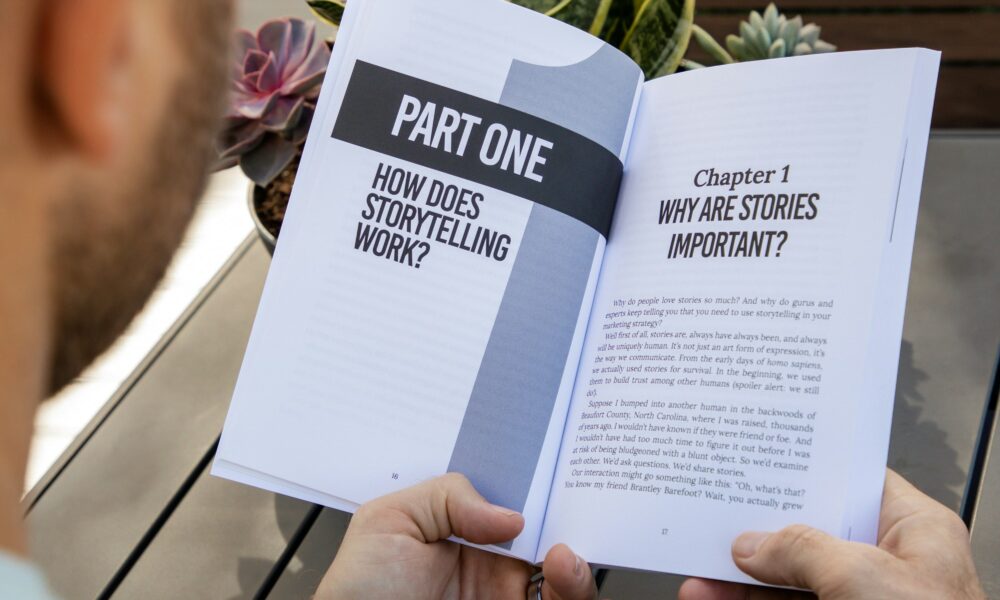
Internal communications are in a state of flux. Most organisations aren’t short on messages. If anything, they’ve got the opposite issue – too many of them.
This is where introducing storytelling principles to your internal communications strategy can make a difference. A clear narrative arc or cadence in your communications can transform them from white noise into something people remember.
The Guide Every Internal Comms Professional Needs
The Internal Comms Bible 2026
Why does storytelling matter so much in internal comms?
Most internal comms strategies are built logistically. It outlines what needs to be said, when it goes out, and where it lives. While this makes sense on paper, people don’t experience work in neatly organised channels.
People experience communications in fragments, half-reading an email between meetings, taking a photo of a slide, or skimming a message on their phone while doing something else entirely. It doesn’t all land all at once. And if your message doesn’t have a shape to hold onto, it just disappears into the noise.
When your internal comms plays out like storytelling, with a predictable cadence, people intuitively know what needs to be absorbed, and what action needs to happen. A beginning, a middle, an end. A “here’s what’s going on” that feels like it actually relates to something real.

What is the science behind internal communication strategies?
Research from Jerome Bruner showed that stories are up to 22 times more memorable than facts alone. A Stanford study backs it up in a slightly uncomfortable way for data-heavy communicators. Only a small number of speakers used stories, but 63% of audiences remembered the story-led ones, compared to just 5% who remembered statistics alone.
Neuroscience takes this idea one step further. When people hear a story, multiple areas of the brain light up at once. People experience information rather than simply process it.
Uri Hasson at Princeton describes it as brains literally syncing between storyteller and listener. While this sounds like the stuff of Philip K. Dick, the message is stories land differently because they feel different.
Facts tell people something, but stories make them feel like they understand it.
Why internal communication struggles without narrative
Most internal communication fails for a simple reason: it competes with everything else happening in a working day.
People are not sitting down and “consuming” internal comms. They’re juggling tasks, meetings, and deadlines. So messages need to work harder to get through.
But a lot of internal comms still relies on:
- long emails
- dense PDFs
- text-heavy slides
- one-direction updates
Even when the internal communications strategy is solid, the execution often isn’t aligned with how people actually absorb information.
Storytelling helps because it creates a mental shortcut.
Instead of processing isolated facts, employees follow a storyline. And that makes internal communication easier to understand and far more memorable.
How does visual communication improve internal communications strategy?
Storytelling becomes even more effective when paired with visual content.
Research shows:
- 95% message retention with video, compared to around 10% with text
- 75% of employees prefer visual aids over text-only internal communication
- Nearly half of employees say video is the most engaging format for internal comms
This is important because central to modern internal communications strategy is how quickly people understand what you’re telling them.
Visual storytelling in internal communications:
- reduces cognitive load
- speeds up comprehension
- improves recall
- increases engagement in internal communication
Instead of sending a long update, successful internal communications and HR professionals are increasingly turning to:
- short-form video updates
- leadership explainers
- visual timelines
- digital town hall content
If your goal is to improve internal communications, visuals can be your secret weapon that helps you reach your people.
How can leadership communication use storytelling to build trust?
One of the most overlooked parts of an internal comms strategy is leadership voice.
More than just routine updates from leadership, employees want sincerity and context. However, there’s often a gap between the perception leaders have with their communication style and the reality.
Many leaders believe they are communicating clearly and openly. Employees don’t always agree.
Research shows authentic leadership communication can increase cognitive trust by over 34%. Trust also increases significantly when employees feel leadership genuinely listens and responds.
This is where storytelling becomes powerful in internal communication, because it allows leadership to:
- explain decisions, not just announce them
- share uncertainty where it exists
- show the thinking behind direction
- humanise communication
Instead of polished statements, storytelling supports more natural internal communication, the kind employees are more likely to trust.
And trust is what determines whether messages in an internal communications strategy actually lead to action.
What are feedback loops and why are they essential for internal communications strategy?
A feedback loop in internal communication is basically what happens after a message goes out. However, internal communication isn’t complete when a message is sent, but when it is understood and responded to.
That’s why feedback is a critical part of any internal communications strategy.
The data is clear:
- Employees who receive regular feedback are more engaged
- Organisations with strong feedback systems see lower turnover
- Recognition and response improve retention and performance
But the problem is that employees feel like feedback channels are inaccessible, despite leaders thinking the opposite. This is why it’s important for internal communications to feel like a dialogue
Without feedback loops, even strong storytelling in internal communication becomes one-directional and eventually less effective.
How to bring storytelling into your internal communications strategy
A strong internal communications strategy focuses on clarity, structure, and memory.
Storytelling supports that by:
- turning updates into narratives
- improving employee engagement
- increasing recall of internal communication
- strengthening leadership trust
- and making complex information easier to understand
When combined with visual communication and the right channel strategy, storytelling becomes the backbone of effective internal comms.
It shifts internal communication from information sharing to meaning creation.
Final thought: turning internal communication into experience
At some point, organisations realise that improving internal communications is about designing better experiences (even more than writing better e-mails).
That’s where many teams bring in a full service events agency, to translate internal communication and internal comms strategy into live experiences, town halls, leadership broadcasts, and digital events that make a real impression on people, helping them remember the message.
When storytelling, visuals, and delivery come together, internal communication becomes something people carry with them even after the conversation has concluded.
Get the latest report on internal communications in 2026.

Ready to take the stress out of event planning?
Live Group helps organisations design and deliver personalised event experiences that engage audiences and achieve results. Contact us to discuss your next event.