2025 was the year AI dominated event decks, demos, and promises, while the lived experience changed far more slowly.
If you work in events, you might have noticed a shift in 2025.
Every platform update mentioned AI. Every vendor demo hinted at it. Every presentation slid it into the agenda somewhere between “future skills” and the lunch break. And yet, when you got back to your desk, most events still ran on the same fundamentals: people, content, logistics, timing, and judgement calls made at speed.
So we’re asking: did AI transform events in 2025, or did it simply nudge them in a new direction?
The honest answer sits somewhere in the middle. AI didn’t flip the industry overnight. But it did quietly shift how teams think about effort, scale, and where human time is best spent. And once you see that shift, it’s hard to unsee it.
This article looks at what actually changed, what stayed stubbornly human, and what event professionals learned the hard way.
What did “AI in events” actually mean in practice?
For most event teams, AI didn’t arrive with a bang. It crept in through small, practical uses. Tools that helped you write faster, analyse quicker, or tidy up messy data without an intern and a strong coffee.
It wasn’t the stuff of sci-fi novels, but more like quiet admin relief.
In 2025, AI showed up in places like:
- Drafting event emails, landing pages, and session descriptions
- Repurposing talks into post-event content
- Summarising feedback forms that nobody had time to read properly
- Translating sessions or transcribing panels at speed
- Answering basic attendee questions through chat interfaces
The fundamentals of event design remained the same. But what did change was how quickly teams could move.
Summary: AI entered events quietly, through tools that reduced friction rather than reinventing the format.
B2B Event Planning Guide 2025
Download the 2026 B2B Event Planning Guide
Why did event content become the easiest win?
If there was one area where AI in events felt genuinely useful, it was content.
Event content is relentless. Pre-event comms, reminder emails, speaker blurbs, stage scripts, social posts, follow-ups. It never ends. In 2025, AI became a way to get a first draft on the page without staring at a blinking cursor.
Many teams used AI to:
- Structure agendas
- Rework the same message for different audiences
- Turn one keynote into five pieces of post-event content
- Clean up rough speaker submissions
That tracks with broader trends. Forrester’s Q1 2025 State Of B2B Events Survey suggests larger organisations are more likely to use AI, but they’re also slower to move from pilots to everyday use. Smaller teams, by contrast, often act first and formalise later.
Still, even here, AI didn’t replace judgement. Someone had to sense-check tone, accuracy, and intent. A machine can write words. It can’t tell if they’ll land.
Summary: Event content became AI’s entry point because it saved time without touching the live experience.
Where did delegates actually see AI in events?
For all the caution around AI touching attendees, delegates weren’t completely shielded from it. In fact, many experienced AI without realising that’s what it was.
The safest place for AI to appear in 2025 was edges of the event. Exhibition floors, content capture, and moments designed for curiosity rather than dependency.
Exhibition booths were the most obvious testing ground. Brands used AI to demonstrate new products, simulate scenarios, or personalise demos on the fly. Instead of a static screen and a sales script, delegates could ask questions, explore options, and get tailored outputs in real time. If it worked, great. If it didn’t, a human stepped in. Low stakes, high interest.
Then there were AI-powered photobooths. Slightly about novelty, but also about shareability and therefore event legacy. Delegates queued for headshots, stylised portraits, or playful visuals that matched the event theme.
AI also appeared quietly in content moments. Session summaries delivered to apps or inboxes within minutes. Key quotes pulled out automatically. Talking points ready before people reached the coffee queue. According to a McKinsey report, most organisations are still using AI at a task level rather than embedding it deeply into workflows, and this is a good example. Helpful, contained, and easy to trust.
What’s important is that none of these replaced human interaction. They were included to enhance it. The booth still had staff. The photobooth still created a social moment. The session summary didn’t replace listening; it helped people remember.
Summary: AI played a visible role for delegates in low-risk, experience-led moments, adding value without taking control.
Were some event organisers hesitant to let AI in?
Not everyone was enthusiastic.
While many teams were happy to use AI behind the scenes, far fewer were comfortable letting it interact directly with attendees. And that caution wasn’t paranoia.
There were real concerns around:
- Data privacy
- Hallucinated answers from chat tools
- Brand risk if something went wrong live
- Losing the human feel events depend on
Only a small minority actively used AI for attendee personalisation, targeting, or assistance. Most said they were interested, but not yet ready.
That hesitation aligns with wider business sentiment. According to McKinsey, while 62% of organisations are experimenting with AI agents, fewer than a quarter are scaling them – and often only in one or two functions. Anything customer-facing still feels like a leap.
Summary: AI that interacts with attendees felt riskier than AI that stayed quietly in the background.
Did budget size influence how AI was used in events?
Absolutely. Event teams with larger event technology budgets were more likely to:
- Experiment with AI data analysis
- Test predictive insights
- Build custom tools instead of relying on vendor promises
Smaller teams focused on simpler gains, mostly content and admin. And that makes sense. If you’re spending six figures on event tech, you can afford to test, tweak, and occasionally bin ideas that don’t work.
Interestingly, some of the most advanced organisations became sceptical of vendor claims. After a year of “AI-powered” everything, a few decided to build their own tools instead of buying shiny dashboards that over-promised.
Summary: The more you spent on event technology, the more nuanced your AI use became.
How did generational attitudes shape AI adoption?
Another quiet influence was age.
Younger marketers often showed more curiosity about how to use AI in an event. Chatbots, predictive targeting, personalised journeys. They saw the potential quickly, probably because they’ve grown up with recommendation engines and automated tools.
But adoption decisions often sat with more senior leaders, who tended to be more cautious. Not anti-AI, just careful. Especially where risk, reputation, or regulation were involved.
That created an odd tension: enthusiasm without authority on one side, authority without urgency on the other.
Summary: Interest in AI skewed younger, while control of adoption stayed older.
Did AI replace any event jobs in 2025?
Short answer: no.
Longer answer: it did change how some roles worked.
AI took over repetitive tasks. Drafting, summarising, tagging, analysing. That freed people up to focus on things machines still struggle with: judgement, empathy, creativity, and live problem-solving.
Anyone who’s worked on an event knows the real value often appears five minutes before doors open, when something breaks and someone calmly fixes it. No algorithm can save you in that moment.
What did change was expectations. Being “good with AI tools” started to look like a baseline skill, not a novelty. While the job didn’t disappear, it did evolve.
Summary: AI shifted workloads instead of headcount, and raised the bar on digital fluency.
Where did AI genuinely improve event technology?
Data.
Event technology produces oceans of it, and most teams barely have time to skim the surface. AI made it easier to spot patterns, summarise sentiment, and connect dots that would’ve taken weeks before.
Used well, AI helped teams:
- Identify which sessions actually resonated
- Understand audience behaviour beyond vanity metrics
- Turn feedback into something actionable
The catch was if bad data went in, bad data still came out. AI didn’t fix poor data hygiene. It just made the consequences faster.
Summary: AI sharpened insight, but only where the underlying data was solid.
Did AI transform events in 2025?
Not in a dramatic sense.
Events didn’t suddenly become automated experiences run by machines. People still designed them. People still delivered them. People still made them memorable. Because people attend events to be among other people, not code.
What changed was the pace. The way ideas moved from thought to execution. The tolerance for inefficiency. The sense that some tasks no longer deserved as much human energy as they once did.
AI didn’t replace the craft of events. It cleared some of the clutter around it.
Summary: 2025 was less about transformation and more about quiet recalibration.
What does AI mean for event professionals going forward?
It means a few uncomfortable but useful things:
- Knowing how to use AI tools will soon be expected
- Blind trust in vendor claims will fade
- Human skills will matter more, not less
- Audience experience will remain the line nobody crosses lightly
And perhaps most importantly, it means events will continue to reward judgement over automation. The best teams will be the ones who know when to lean on technology and when to ignore it.
A simple template: how to use AI in an event (without overthinking it)
If you’re wondering where to start, try this lightweight framework:
1. Pick one pain point
Choose something slow or repetitive, like post-event content or feedback analysis.
2. Test one tool
Use it for drafts or summaries, not final outputs.
3. Add human review
Always. Tone, accuracy, context matter.
4. Measure the time saved
If it doesn’t save time, drop it.
5. Stop before the audience notices
If attendees can tell a machine is running the show, you’ve probably gone too far.
One last thing worth remembering
There’s a reason many organisations still rely on full-service event agencies. Beyond delivery, they bring judgement, experience, and reach.
That includes the bits that happen after the lights go down. Press releases. Media distribution. Knowing who actually wants the story and how to pitch it. A good agency doesn’t just run the event; they help shape how it lands in the wider world, using their contact base to get it seen.
AI can help draft the words. It can’t replace the relationships.
And in events, relationships still matter.
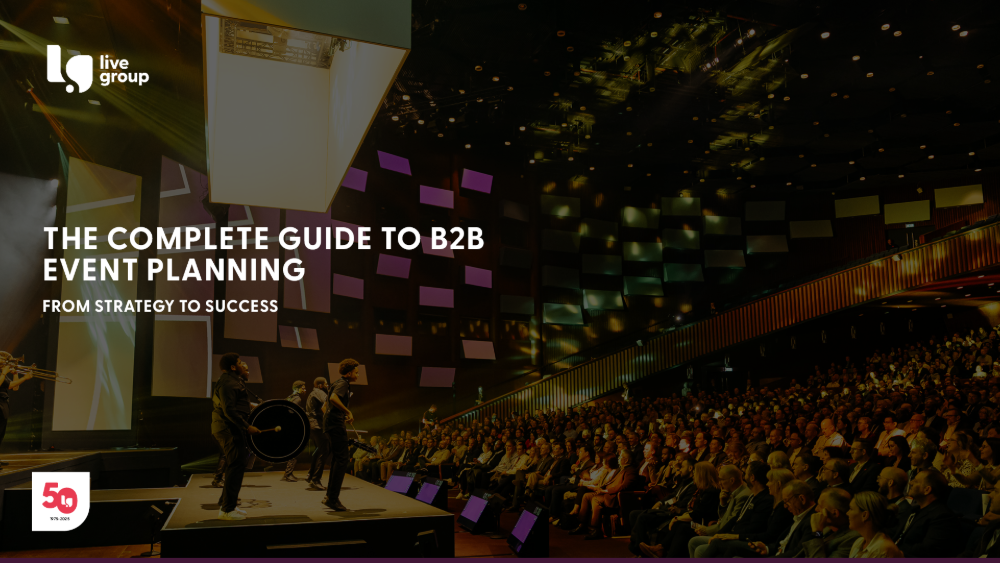
Download the B2B Event Planning Guide for the complete playbook to planning events in 2025-26
Ready to take the stress out of event planning?
Chat to us today about how our delegate management services can help bring your next event to life – on time, on budget, and beyond expectations. Whether you need full-scale delivery or targeted support, Live Group is here to help.