

What is an internal communications strategy (and why do so many get it wrong?)
An internal communications strategy sounds formal, perhaps even a bit dry. In practice, it’s much simpler: it’s the system a business uses to make sure the right people hear, understand, and act on the right messages.
That could mean a leadership announcement, a policy change, a culture initiative, or an event rollout. But unfortunately, businesses too often treat communication in the workplace like tossing leaflets from a moving car. Everyone gets the same thing, same wording, same format, and the same amount of time. If your messages aren’t landing, this could be one of the reasons why.
High frequency communication does not automatically mean better communication. In fact, poorly targeted communication can do the opposite. It creates noise, teaching employees to tune out. Like a group chat that never stops buzzing, people eventually mute it.
Gallagher’s State of the Sector research found that only 18% of communicators use audience profiles or personas to segment internal audiences. That means most organisations are still relying on blanket messaging rather than tailored communication. The outcome is a drop in relevance and attention, with internal comms becoming little more than white noise.
In short: if your strategy treats every employee the same, your audience probably stopped listening a while ago.
Why does data matter in internal communications strategy?
Data gives internal comms something many teams have historically lacked: evidence.
Gone are the days of “we’ve always done it this way”, because comms professionals can make informed and intentional decisions about how best to communicate with exactly who they are trying to reach.
A strong internal communications strategy should be built on three types of audience intelligence:
1. Demographic and structural data
This includes:
- Role
- Seniority
- Department
- Location
- Working pattern (remote, hybrid, deskless)
- Length of service
Most companies already hold this in HR systems. The problem is it is so rarely used to shape communications.
2. Behavioural data
This tells you:
- Which channels employees actually use
- Email open rates
- Intranet clicks
- Video watch time
- Survey participation
- Event attendance
Behavioural data is particularly robust for comms strategies because it shows what people do, not what they say they do.
3. Attitudinal data
This relates to opinions and feelings:
- Sentiment
- Trust in leadership
- Understanding of company goals
- Feedback quality
- Employee confidence
This is often gathered through pulse surveys, feedback tools, or sentiment analysis platforms like Staffbase, Poppulo, or Culture Amp.
Together, these data points create a hyper-personalised communication map, not unlike how your personalised feed recommends what you’ll be interested in seeing next.
Put simply: data helps internal comms stop broadcasting and start connecting.
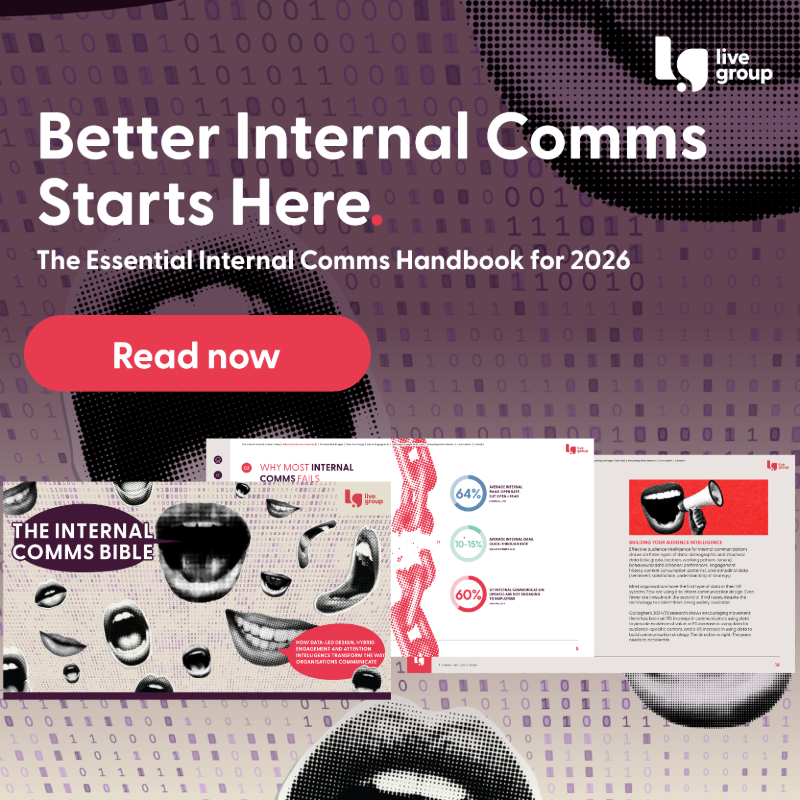
The Guide Every Internal Comms Professional Needs
The Internal Comms Bible 2026
How to improve internal communications through segmentation
Now personalisation is the norm in most arenas, one-size-fits-all no longer suffices. Segmentation means dividing employees into meaningful groups and tailoring communication to fit them.
For example:
- Frontline staff may need mobile-first updates
- Senior leaders may need strategic detail
- Regional teams may need location-specific messaging
This signals a dramatic contrast between how each demographic prefers to communicate, which is exactly why a blanket comms strategy won’t land.
Augusta University reportedly tripled email open rates after implementing personalised communication. Proving that engagement goes up when people receive information that actually matters to them.
In practice, a personalised internal communications strategy might look like this: if a weekly company-wide newsletter lands in every employee’s inbox, but most updates are only relevant to a small portion of the workforce, disengagement happens quickly. People start to assume the content isn’t for them, tune out, and may even overlook genuinely important updates later on. Segmenting your communications changes that. For example, frontline teams might receive operational updates and shift-related news, while senior leaders get strategic business insights, and regional offices receive location-specific announcements. Over time, employees come to expect communication that is relevant to their role, making them far more likely to pay attention when it arrives.
Poppulo’s analysis of billions of communications also found targeted leadership messaging significantly outperformed broad internal broadcasts.
Segmentation can feel like more work and planning initially. But over time, it usually means less wasted effort because teams stop investing their time into tasks that miss the mark.
Better segmentation often means fewer messages, but far better outcomes.

How do pulse surveys and sentiment data strengthen internal comms?
If segmentation is about knowing who you’re talking to, listening is about knowing whether it’s working. Annual surveys alone are like checking the weather once a year and assuming you’re prepared for every season.
Employees want more regular opportunities to share feedback. Research consistently shows that frequent, lightweight pulse surveys offer richer, more actionable insight than annual reviews alone.
A good pulse survey should be:
- Short
- Relevant
- Timely
- Easy to complete
- Followed by visible action
There’s little point asking employees what they think if nothing changes. Silence after feedback can erode trust faster than not asking at all.
When organisations listen, act, and clearly communicate what changed, trust and leadership credibility grows.
Think of it as a loop:
- Listen
- Learn
- Adapt
- Communicate
- Repeat
It sounds obvious. Yet many companies still break the chain at “listen.”
Data without action is decoration but data with action becomes strategy.
How companies communicate internally across generations, are you speaking everyone’s language?
A modern workforce isn’t made up a single audience, but rather several smaller audiences within it.
By 2025, Millennials and Gen Z make up a substantial share of employees, and their communication preferences often differ sharply from Boomers or Gen X.
Broadly speaking:
- Boomers often value face-to-face and detailed updates
- Gen X may prefer concise email
- Millennials lean towards collaborative platforms
- Gen Z tends to favour short burst messaging and visual communications
This doesn’t mean stereotyping people into boxes, because there is always variation within it, but it does mean recognising habits.
A five-page policy email may land well with some groups and vanish completely with others.
Good internal comms strategy doesn’t ask “what do we want to send?” but “How is this audience most likely to engage?”
The best communication strategies adapt format as much as message.
Why does internal communications forget about frontline workers?
Many businesses focus internal comms on desk-based employees while the majority of global workers are frontline or deskless.
These are often the people delivering the customer experience, representing the brand physically, and keeping operations running. Yet they’re frequently the last to hear about internal updates.
Frontline workers often face:
- Limited desktop access
- Poor communication tools
- Inconsistent leadership visibility
- Lower engagement
Mobile-first platforms, SMS alerts, app-based communication, and operationally relevant updates can dramatically improve this.
Your internal comms strategy must include frontline team members, or it isn’t complete.
Reach everyone, or risk building communication systems with glaring blind spots.
How to create an internal communications strategy that works in 2026
Where do you start when building an internal comms strategy that delivers?
A practical framework looks like this:
Audit
Review existing channels, engagement metrics, and content performance.
Segment
Group audiences by role, behaviour, and communication preference.
Listen
Use pulse surveys, sentiment analysis, and feedback loops.
Personalise
Adapt content, timing, and format.
Measure
Track open rates, participation, trust, and behavioural outcomes.
Refine
Strategy shouldn’t be static, keep tweaking it and treating it like a living organism.
Like event planning, internal comms rarely succeeds through guesswork alone. You test, adjust, and improve.
A data-led strategy turns communication from assumption into infrastructure.
Why does this matter beyond internal comms?
Because internal communication shapes culture, retention, trust, and performance.
When employees feel informed, heard, and understood, they’re more likely to stay, engage and become advocates for the business.
And when major campaigns, change programmes, or internal events need broader visibility, partnering with a full-service events agency can extend that reach far beyond logistics alone. Through town halls, strategy kick-offs, leadership roadshows, tailored communications planning, and audience-focused training, events can become the missing ingredient in a stronger internal communications strategy. Rather than simply sharing information, they create moments people actually experience – helping organisations reinforce messaging, build trust, and reshape how communication lands across the business.
Data builds better internal communication. Strategic partners can help it travel even further.
Final thoughts: Internal comms should feel less like noise and more like relevance
The old broadcast model is quickly fading. Employees expect communication that feels timely, useful, and relevant. What they’ve, frankly, had enough of is endless generic updates clogging inboxes and causing unhelpful distraction. Data is what makes a more relevant comms strategy possible.
Internal communications strategy works best when it stops shouting at everyone and starts speaking to someone.
Get the latest report on internal communications in 2026.
Ready to take the stress out of event planning?
Live Group helps organisations design and deliver personalised event experiences that engage audiences and achieve results. Contact us to discuss your next event.