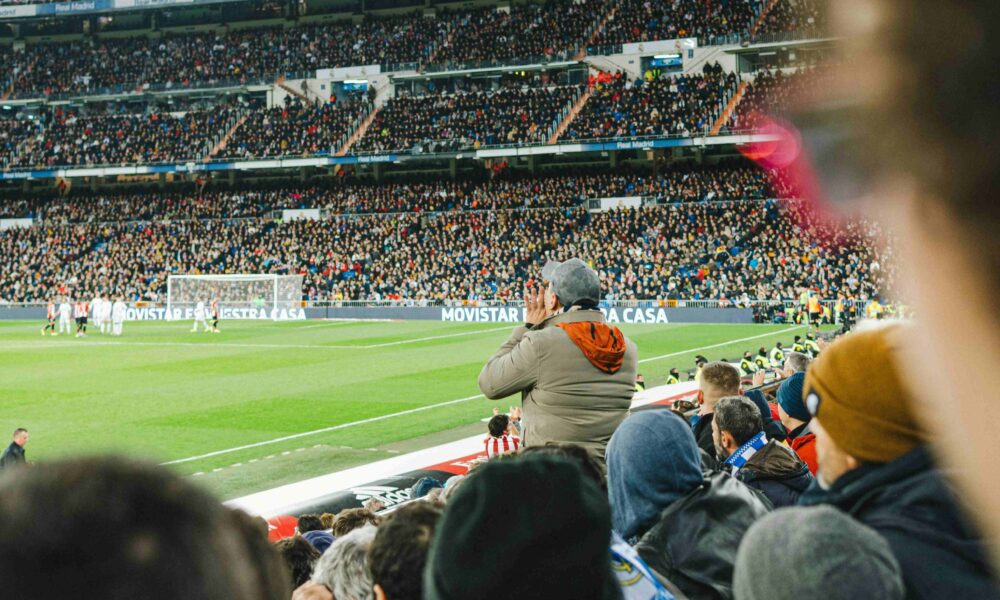
Sporting events turn crowds into participants by design. Most events still rely on hope.
Why are sports events so good at turning spectators into participants?
If you’ve ever attended a live sporting event, you probably didn’t just sit there quietly. You likely got involved: chanting, cheering, singing, standing, sitting, and even bonding with complete strangers. It’s one of the few settings that genuinely fuels camaraderie, rivalry, connection, and real engagement.
Understandably, this is the kind of attendee reaction many event designers envy.
For sporting events, engagement is baked in, and fans are expected to respond. Whether it’s football, Formula One, or basketball, the same truth keeps popping up: participation creates memory.
For anyone working in event planning, event production, or brand activation, that’s a useful starting point. Because most corporate or public-sector events still rely on a quiet room, a stage, and hope.
Sporting event organisers don’t need to hope for that kind of engagement, because it’s carefully choreographed.
B2B Event Planning Guide 2025
Download the 2026 B2B Event Planning Guide
What do immersive sports experiences actually do differently?
The mild contradiction is that immersive sports experiences often feel effortless, but they’re anything but.
What they do well is remove friction. Instructions are obvious. Feedback is instant. Participation feels safe, even for people who claim they “don’t really like sport”.
Look at modern fan zones or stadium installations and you’ll spot a few patterns:
- Clear entry points (no awkward “what do I do?” moment)
- Short cycles of action and reward
- Social comparison without pressure
- Physical movement paired with digital feedback
It’s why a football simulator or racing setup in the corridor or atrium draws crowds so quickly. Attendees understand the rules in seconds.
This matters for event content beyond sport. People don’t want to read a manual before they engage. They want permission to join in, and a reason to care.
Summary: Immersive sport works because it’s simple on the surface and considered underneath.
What ideas can event designers steal without copying sport wholesale?
You don’t need a stadium or athletes. And you definitely don’t need fake chants piped through speakers.
What is worth stealing are the mechanics.
1. Give your delegates a role
In sport, everyone has a part: supporter, rival, underdog, first-timer.
Events can do the same. Attendee, contributor, challenger, collaborator.
2. Build moments
Sports events are remembered in highlights.
Event programmes are often remembered as just that – programmes.
Design for spikes of energy, then allow calm.
3. Let people measure themselves
Gamified activities that have leaderboards, scores and progress bars. Don’t underestimate the power of motivation and gratification for your event attendees.
4. Design for groups
Sport is social first. Events should be too.
None of this requires copying a sport event in content, but it is about borrowing the psychology.
Summary: The fundamental lesson from sporting events is structure.
Case Study: How did Real Madrid turn stadium corridors into an experience?
The Real Madrid Bernabéu project is a useful example precisely because it isn’t flashy for the sake of it.
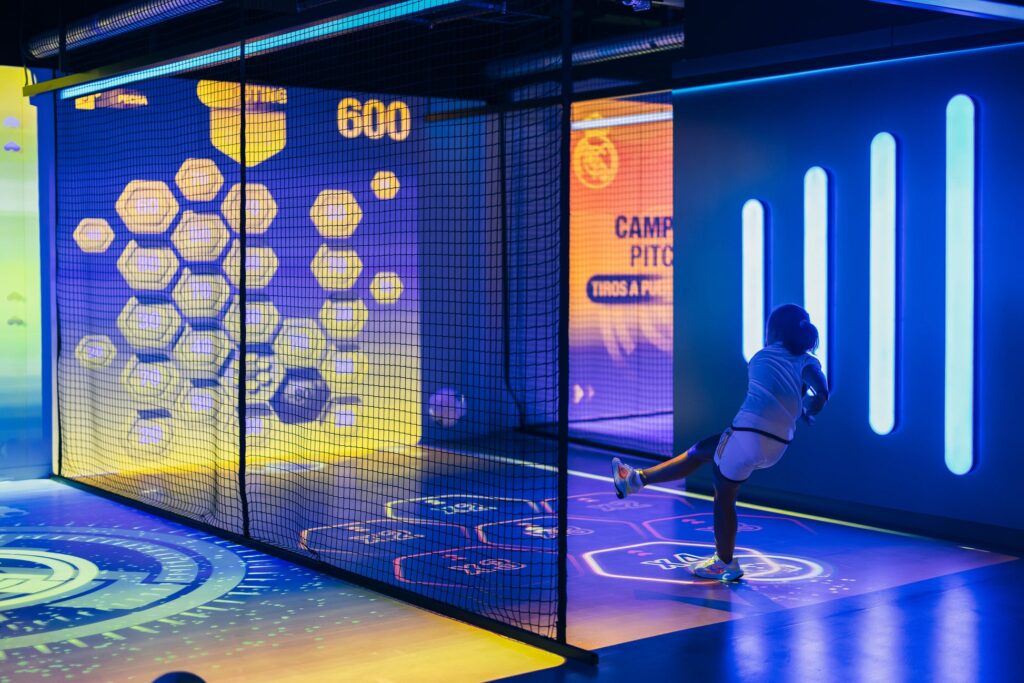
Instead of building something separate, the club – working with Moment Factory – treated unused stadium corridors as an opportunity. Visitors create avatars, take part in football-based challenges, and see their performance tracked in real time. Lighting, projection, sound, and feedback do the heavy lifting.
A few things stand out when you strip away the tech:
- The experience works for all ages
- Participation is physical, but forgiving
- Comparison is playful, not intimidating
- The setup disappears on match days
This is event production thinking at its sharpest: flexible, modular, respectful of the venue’s primary job.
For event professionals, the takeaway is that unused space can still carry meaning if you treat it as part of the story.
Summary: Immersion works best when it respects the environment it lives in.
How can I Create “Can’t Miss” Moments at my Event?
Another way to design events worth ignoring phones for is to include experiences so memorable and exciting that no one wants to miss them. In event planning, think about how to create “wow” moments, the kind that grab hold of your audience’s attention and refuse to let go.
This could be a captivating story or case study that unfolds during a keynote, an inspiring live demonstration of a new technology, or a surprise guest speaker. It might be an immersive audio-visual experience with dramatic lighting, music, or video that transforms the atmosphere. Use storytelling, emotion, and sensory elements to draw people in on a human level. If you can trigger an emotional response, laughter, curiosity, inspiration, even a bit of suspense, attendees will be too wrapped up in the experience to even think about their phones.
Also, consider the environment and staging. Creative stage design, lounge areas for networking, interactive exhibits, these all contribute to an immersive event where there’s always something interesting happening in the physical space. For instance, having live sketch artists summarise sessions visually, or setting up product demo stations that people can try, gives attendees unique, tangible things to focus on. The goal is to deliver experiences attendees simply can’t get from staring at a screen. When your event offers that kind of exclusive value, phones naturally take a back seat.
How to Respect Attention Spans at your Event (with Breaks)
Designing an event worth ignoring phones doesn’t mean every second must be jam-packed. In fact, respecting your attendees’ attention spans and energy levels will help keep them off phones in the long run. Plan your schedule with strategic breaks and buffer times. Short pauses allow attendees to quickly check important emails or messages if needed, so they’re less anxious about “what am I missing?” during sessions. When people know they’ll have a chance to catch up with the outside world soon, they can relax and give their full focus to the present moment.
Moreover, aim for quality over quantity in your content. Curate your agenda to avoid information overload. Five great, concise sessions will beat ten drawn-out ones where half the audience disengages. If a topic can be covered in 30 minutes, don’t stretch it to an hour. Attendees appreciate when you value their time, and when they’re not mentally exhausted or overloaded, they stay engaged. Remember, boredom and fatigue are what send people running to the refuge of their phones. By keeping content tight, relevant, and giving ample breaks, you remove those reasons to escape.
Final Thoughts: How Can Your Event Make Attendees Forget About Their Phones?
In a world where smartphones are omnipresent, the answer isn’t to fight against them, it’s to outshine them with an event experience that holds attention by choice. When you design an event that is interactive, personalised, and filled with meaningful moments, you won’t need to demand attendees’ attention. You’ll earn it.
For any event management company aiming to improve audience engagement in the current attention economy, you’ll need something other than more tech — you need to design events people genuinely want to be part of.
So, stop competing with phones and start creating events worth ignoring them for. By prioritising engagement, relevance, and experience in your event design, you’ll captivate your audience from the first speaker to the final closing remarks. And when attendees are fully engaged and present, that’s a win-win, for them, for you, and for the success of your event.
Download the B2B Event Planning Guide for the complete playbook to planning events in 2025-26
Ready to take the stress out of event planning?
Live Group helps organisations design and deliver personalised event experiences that engage audiences and achieve results. Contact us to discuss your next event.